Selfreplication
Mutual Impact
| f[state[j, i], rule[#], max age] = f[state[j, i - 1], rule[#], state[j
- 1, i - 1]] |
| f[state[j-1, i], rule[#], max age] = f[state[j-1, i - 1], rule[#],
state[j , i - 1]] |
Self impact
| f[state[j, i], rule[#], max age] = f[state[j, i - 1], rule[#], state[j
, i - 1]] |
Hitherto most interactions between CA were mutual . Their mutual impact was I={i , j}. In
the present experiment a CA interacts with itself. Its state sets the age
distribution and I = {i, i}
A similar interaction was described in chapter
17
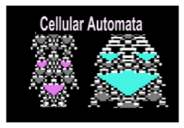
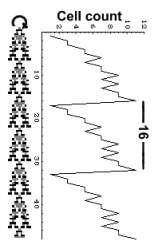
The first image depicts an
oscillating CA with a period
of 16 days
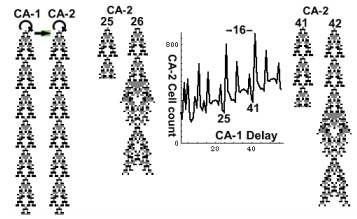
The next image depicts two self impacting CA. In addition CA-1 interacts
with CA-2. First CA-2 zygote
was planted. Then CA-1 was planted at rising times. The cell count oscillates with a period of 16 days .
Throughout one cycle CA-2 assumes different shapes. When the cycle
is over CA-2 elongates by a triangular segment.
Differentiation
cycle
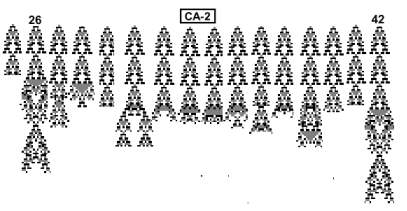
The above image depicts CA-2 changes during one cycle. At delay time = 26
CA has one triangular structure, During
the next cycle it adds one triangular structure to the chain.
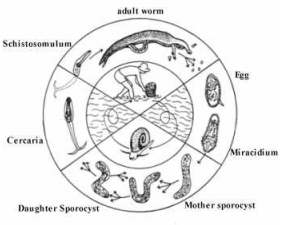
Similar life cycles are observed
in helmintes like schistosoma mansoni.
http://www.biologie.uni-erlangen.de/parasit/contents/research/schisto.html
Setup
a[[1, x1 ]] = 0; x2 = 25 ; seedtime = *; effect [1,1, 20 - sa[[1]]; effect[2,
2, 20 - sa[[2]] + sa[[1]];
Previous page
Next page