 |
We continue the experiment of the previous chapter, Plant two zygotes, let them evolve, and start our experiment at t = 150, when the system has reached a steady state. The interaction between the two CA is stopped at rising times.
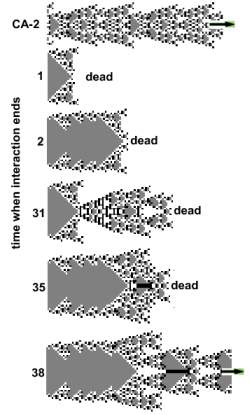 |
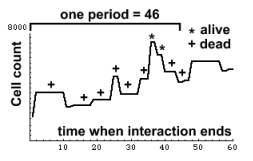
When interaction ends, in most cases CA-1 continues living for a while and then dies. Only at times 36-39 it survives, creating a new oscillator with a period of 29 time units (compare with chapter 48). The following graph depicts cell count of CA-2 after the interaction stopped.
 |
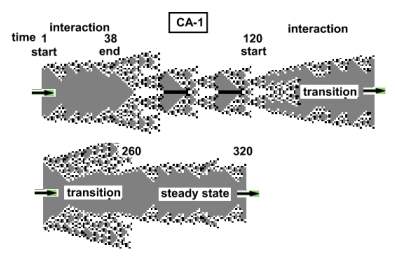 |
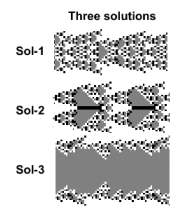
CA-1 repertory consists of three solutions (stable states).
Transitions are generally dangerous since they may
end in death. In the present experiment
CA-2 protects
CA-1 from dying even during transitions.
 |
Setup
injurystate[1, j, 1, iend =1000, f[[2, 1]],
3. nowdat[[2,10]],1]; injurystate[1, j, 1, iend = 1000, f[[2, 2]], 3. nowdat[[2,
10]],1]; Stop interaction: iend = mm