Individual time
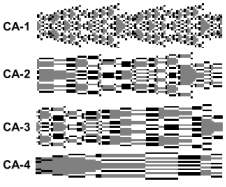
Hitherto all CA
were updated synchronously. The present experiment describes
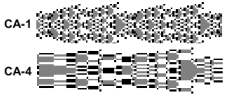
asynchronous update. The system includes four CA. Three are updated
synchronously, and CA-4, asynchronously, The two CA below are isolated and non-interacting. CA-1
stayed in its state one
time unit, while CA-4 stayed between
1-3 time units. Its progression from state to state was controlled by
CA-1.
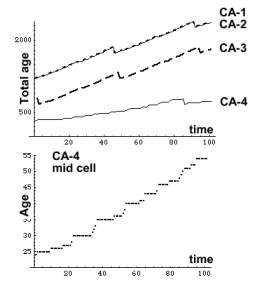
Age is accumulated only when changing a state,
and CA-4 aged more slowly than CA-1. Its age rose in steps, like that of the
mid line cell. The horizontal segment of the age curve depicts the length
of its stay in each state. CA-4 traverses through the same
46 states like CA-1 While CA-1 period
is 46, can CA-4 oscillation still be regarded as periodic? It’s
states are periodic while its time line, is not.
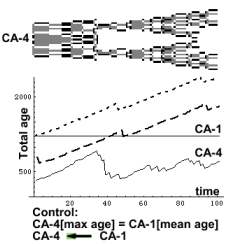
The image below depicts CA-4 differentiation (compare with
the previous experiment).
The CA
below traverse their states at different rates.
Their concurrent state configuration will hardly ever be repeated.
The system is aperiodic, and
CA interaction, an asynchronous computation.
Setup
nca=4 zygote
-> effect[no 1000]; go[63]; go109]; step [ j ] < - If [a[[1 ,50]] == Mod[j, 3], update[4]] go109]; restoreparams; effect[4, nowdat[[1, 7]], 0]; donate[4, 1]; go [100];
Previous
page
Next page